

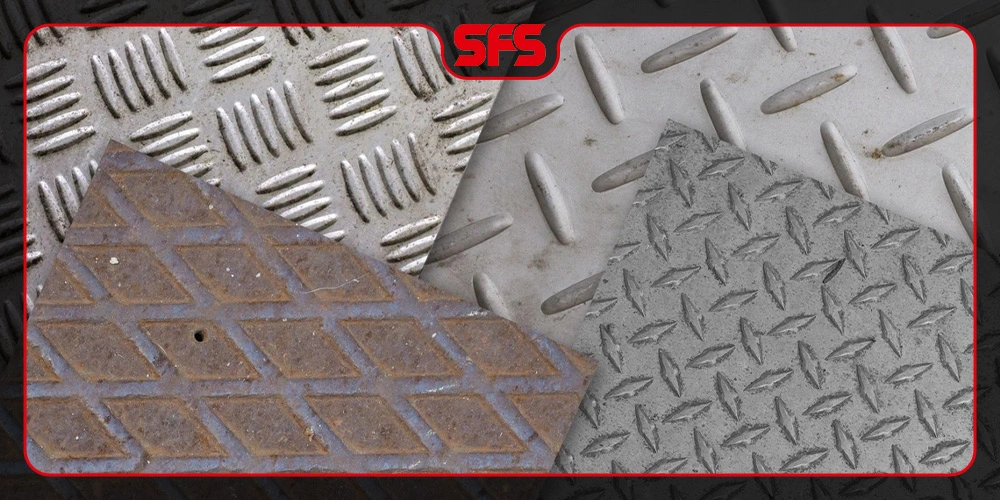
Checkered steel plate is one of the key products in the construction and metal structure industries, playing a vital role in enhancing structural strength and performance. This metallic product, with its distinctive raised patterns (embossing), offers a wide range of technical and engineering capabilities for civil and structural engineering professionals.
A checkered steel plate is a flat steel sheet whose surface contains geometrically regular protrusions and indentations (patterns) designed to maximize the bond and adhesion between steel and concrete.
Importance in the Construction Industry
The significance of checkered steel plates in construction can be evaluated from several perspectives:
-
Enhanced Structural Strength: The raised patterns contribute to efficient force transmission and stress distribution within the structure.
-
Improved Bonding: Ensures excellent adhesion between concrete and steel.
-
Reduced Risk of Slippage: Minimizes the likelihood of detachment and sliding in concrete joints.
-
Economic Efficiency: Extends service life of structures, thereby reducing maintenance costs.
Primary Applications of Checkered Steel Plate
-
Reinforced concrete structures
-
Bridges
-
Residential and commercial buildings
-
Industrial structures
-
Marine structures
Technical Features of Checkered Steel Plates
Checkered steel plates are manufactured under strict standards and are typically made from high-quality carbon steel, offering optimal strength and flexibility. These plates are critical to structural reinforcement and are considered one of the fundamental elements in civil engineering.
Technical Specifications of Checkered Steel Plate
Dimensions
Checkered steel plates are produced in a wide variety of sizes:
-
Width: Typically between 1 to 2 meters.
-
Length: Ranges from 2 to 12 meters.
-
Thickness: Varies from 2 mm to 20 mm, depending on the application.
Common Standard Thicknesses
-
2.5 mm
-
3 mm
-
4 mm
-
5 mm
-
6 mm
Each thickness is suitable for specific applications, depending on structural loads and design requirements.
Checkered Steel Plate Material Composition and Quality
Checkered steel plates are manufactured from high-grade steels with precise chemical compositions, including:
-
ST37
-
ST52
-
ST60
-
A615
These steels offer exceptional mechanical properties, making them ideal for structural applications. Key characteristics include:
-
High tensile strength
-
Excellent weldability
-
Corrosion resistance
-
Sufficient flexibility
Production adheres to stringent international standards, with rigorous quality control measures to ensure high toughness and uniform metallurgical structure. The precise design of the raised patterns ensures optimal bonding between steel and concrete.
Selecting the appropriate steel grade depends on environmental conditions, load factors, and structural requirements. Experts recommend evaluating technical specifications against project demands and verifying the manufacturer’s quality certifications.
Material Properties
Key physical and mechanical properties that determine the performance of checkered steel plates include:
-
High Tensile Strength: Essential for bearing tensile loads in structural systems.
-
Superior Weldability: Facilitates precise and strong joints in metal frameworks.
-
Corrosion Resistance: Enhances durability and structural lifespan.
-
Good Flexibility: Ensures effective performance under variable loading and environmental conditions.
-
High Toughness: Improves energy absorption and impact resistance.
These attributes make checkered steel plates effective not only under static loads but also dynamic forces such as earthquakes and wind. Structural engineers can leverage these properties to design safe and resilient civil and industrial projects.
Types of Checkered Steel Plates
Checkered steel plates are categorized based on application, design, and standards, each with distinct benefits:
Based on Pattern Orientation
-
Longitudinal Pattern Plates
-
Embossed lines run parallel to the sheet’s length
-
Suitable for tensile load transfer
-
Used in structures with axial loading
-
-
Transverse Pattern Plates
-
Embossed lines run perpendicular to the sheet length
-
Improve concrete bonding
-
Provide high shear resistance
-
-
Diagonal Pattern Plates
-
Embossed lines set at a specific angle
-
Offer more uniform stress distribution
-
Enable multidirectional force transfer
-
Purchasing Recommendations
Key considerations when selecting the right checkered steel plate include:
-
Precise understanding of project requirements
-
Consultation with structural engineers
-
Compliance with relevant standards
-
Environmental and load analysis
Selecting the correct type of checkered plate significantly impacts structural durability and efficiency.
Do you need consultation on choosing the right checkered steel plate for your project? Feel free to contact our experts at your convenience.

